
Commercial Vehicle Windscreen Repairs Tauranga BOP
HQ Windscreens Tauranga offers commercial vehicle windscreen repair and replacement services with experience since 2016 across the Bay of Plenty, covering trucks, buses, vans, utes and heavy machinery. Commercial glass work calls for heavier-duty equipment than standard passenger vehicles, including hydraulic lifting platforms to reach cab-height windscreens, laminated safety glass rated to NZ Transport Agency standards, and ADAS recalibration tools where a forward-facing camera is fitted behind the screen. Commercial vehicle glass work is one part of our full windscreen repair Tauranga service.
A damaged windscreen on a commercial vehicle is not just a visibility hazard, because it can ground a vehicle, affect ADAS camera calibration, and create compliance issues under New Zealand's Warrant of Fitness and Certificate of Fitness inspection standards. We offer prompt mobile repairs across Tauranga, meaning minimal downtime whether it is a single work van or a full fleet.
Request a Free Quote
We reply fast. No call-out fees, no hidden costs.
On-Site Repairs
Commercial Fleet On-Site Windscreen Repairs
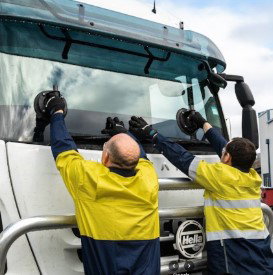
We operate a 100% mobile service, meaning our technicians come directly to your depot, yard, or job site anywhere in Tauranga and the wider BOP region. This eliminates the need to pull vehicles off the road and transport them to a workshop, which is a significant advantage for fleet operators managing multiple units. Appointments are usually available within a day or two for eligible repairs, and we work with fleet managers to schedule around shift patterns and delivery windows. We carry OEM-quality glass and materials on our mobile units, so repairs meet manufacturer specifications on the first visit.
Common commercial fleet vehicle types we service include rigid trucks and tractor units, courier and delivery vans, utes and light commercial vehicles, buses and coaches, and construction and earthmoving equipment.
Emergency Response
Emergency Response Services in Tauranga, BOP
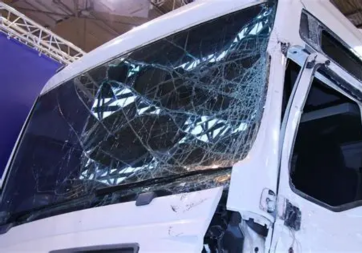
A cracked or shattered windscreen on a commercial vehicle is not only a safety risk, it is a compliance issue that can ground a vehicle immediately under NZTA rules. We work across Tauranga, Mount Maunganui and the Western Bay of Plenty, and urgent jobs can be prioritised, including after hours or at weekends, to minimise vehicle downtime. We lodge insurance claims for you from the first call to job completion, with transparent upfront pricing so there are no unexpected costs once the technician arrives on site.
Advanced Techniques for Heavy-Duty Vehicle Glass
Heavy-duty vehicles such as logging trucks, port machinery, and transit buses use thicker, often laminated glass with specific fitment requirements, so standard repair methods used on passenger vehicles are not always appropriate. We use resin injection repair for smaller chips and bullseye cracks where structural integrity can be restored. For damage beyond repair thresholds, full replacement with OEM-quality glass is performed, with proper urethane adhesive curing times observed before the vehicle returns to operation. We also arrange ADAS calibration through our specialist partner, and many modern commercial vehicles, including newer Isuzu, Hino, and Fuso trucks, have forward-facing cameras that require recalibration after glass replacement.
Materials Used for Heavy Vehicle Windscreens
Commercial vehicle windscreens are laminated safety glass, consisting of two glass layers bonded by a polyvinyl butyral interlayer, which keeps the glass intact during impact rather than shattering. We use OEM-quality glass matching the original manufacturer specifications for thickness, curvature, and acoustic properties. For buses and heavy trucks this matters because substandard glass can affect structural integrity, since the windscreen contributes to cab rigidity in rollover scenarios. Repair resin injected into chips and cracks is a UV-cured optical resin matched to the glass's refractive index, restoring clarity and strength without requiring full replacement when the damage criteria are met.
Damage Types
Types of Commercial Windscreen Damage
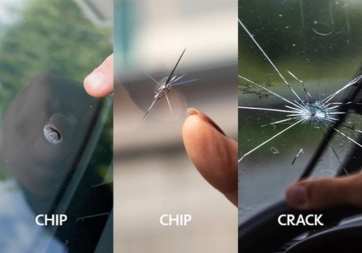
Heavy vehicles like trucks, buses, and vans operate at higher cab heights, which exposes their windscreens to a wider range of road debris. Common damage types include bullseye chips caused by small stones or gravel, star breaks with multiple cracks radiating from a central impact point, long cracks often caused by temperature stress or vibration, edge cracks that start within 5cm of the frame and spread quickly, and combination breaks with multiple damage types from a single impact. Commercial vehicles operating on routes like State Highway 2 through the Bay of Plenty frequently encounter loose metal and chip seal surfaces, making impact damage particularly common in this region.
Compliance
Local Regulations & Safety Standards
In New Zealand, a windscreen with damage in the driver's critical vision zone can result in a Warrant of Fitness failure under NZTA's inspection standards. With industry experience since 2016, we understand what inspectors look for and ensure every repair or replacement meets the required standard before the vehicle goes back on the road.
| Requirement | Detail |
|---|---|
| WoF/CoF inspection | Damage in the swept area or the driver's line of sight must be repaired or replaced. |
| ADAS recalibration | Required after any full windscreen replacement on equipped vehicles. |
| Adhesive cure time | Minimum safe drive-away time must be observed post-installation. |
| Glass standard | Replacement glass must meet AS/NZS 2080 or an equivalent approved standard. |
Repair Vs Replace
Repair Versus Replacement Assessment
Not all damage requires a full replacement. We assess each windscreen using clear criteria to determine the right course of action. ADAS-equipped vehicles require windscreen replacement to be followed by sensor recalibration, and many modern commercial vehicles, including late-model Isuzu NPRs and Hino 300 Series trucks, carry lane departure and collision warning systems that depend on camera placement relative to the glass.
| Factor | Repair Likely | Replacement Required |
|---|---|---|
| Chip size | Up to $1 coin size | Larger than a $1 coin |
| Crack length | Under 15cm (6 inches) | Over 15cm, or reaching the edge |
| Location | Away from the driver's line of sight | Within the driver's direct sightline |
| Depth | Surface layer only | Through the inner laminate |
| Edge proximity | Centre of glass | Within 5cm of the frame |
Truck Windscreen Replacement
Heavy vehicle replacement for transport operators and owner-drivers.
Bus Windscreen Replacement
Mobile bus and passenger transport glass built around depot schedules.
Fleet Vehicle Glass Management
Ongoing glass damage management with consolidated billing and priority booking.
Questions
Commercial Vehicle Windscreen Repair FAQs
What types of commercial vehicles can be repaired, including trucks, buses, vans, and heavy machinery?
We work on a wide range of commercial vehicles, including light commercial vans, rigid trucks, articulated trucks, buses, coaches, and heavy machinery such as excavators and forklifts. We source OEM-quality glass to match each vehicle's specifications, and our 100% mobile service means we come to your depot, yard, or worksite rather than requiring the vehicle to be transported.
When is a chip repair safe, and when does it need a full replacement for a commercial vehicle?
A chip repair is generally appropriate when the damage is no bigger than a NZ $1 coin, is not in the driver's primary line of vision, and does not extend to the edge of the glass. Edge cracks are structurally more serious and typically require full replacement. Commercial vehicles under a Certificate of Fitness face stricter standards than passenger vehicles.
Which repair methods are used, such as resin injection, crack stabilisation, and ADAS recalibration?
Resin injection is the primary method for chip and short crack repairs, drawing air out and curing UV resin to restore clarity and strength. Crack stabilisation involves drilling a small relief point to stop a crack spreading further. ADAS recalibration is carried out whenever a windscreen is replaced on a vehicle fitted with forward-facing cameras or collision sensors.
How long does a commercial windscreen repair take, and can it be done on-site?
A chip or small crack repair typically takes 30 to 60 minutes. A full replacement generally takes 2 to 3 hours, depending on the vehicle, with any ADAS recalibration arranged as part of the job. Our mobile technicians carry the equipment and glass stock needed to complete most jobs at your location, so vehicles can often return to service the same day.
What local compliance and safety standards apply, including WoF/CoF considerations?
Commercial vehicles carrying goods or passengers for hire require a Certificate of Fitness, with more frequent inspections than a standard WoF, and glass condition is a formal inspection point. Windscreen damage that impairs the driver's forward view, or glass that is not correctly bonded or sealed, can result in a COF failure. We ensure every repair and replacement meets the required standard.
How does operating in Tauranga and the Bay of Plenty affect windscreen damage risk?
Tauranga is home to the Port of Tauranga, New Zealand's largest export port by volume, and heavy freight traffic on routes like State Highway 2 and State Highway 29 increases the likelihood of stone chips and road debris strikes. High sunshine hours accelerate chip degradation, and coastal salt air can work into unsealed chips over time, so we recommend fleet operators schedule regular windscreen inspections.
Find Us in Papamoa
Ready to get your windscreen sorted?
Call now, book online or request a free quote. Mobile service across Tauranga and the Bay of Plenty, appointments usually within a day or two.